Search This Blog

Wednesday, July 22, 2009

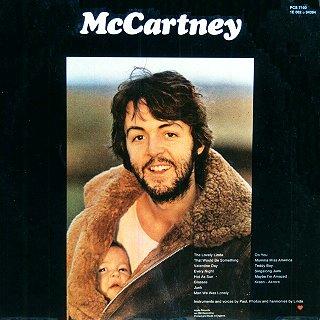
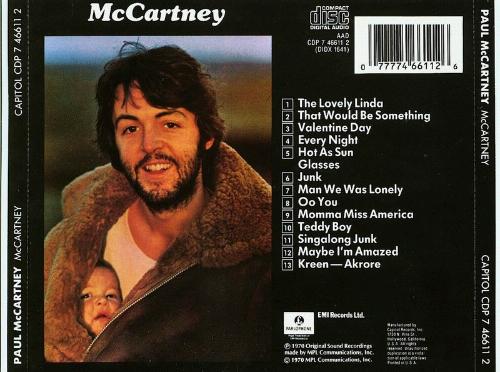
McCartney (1970)


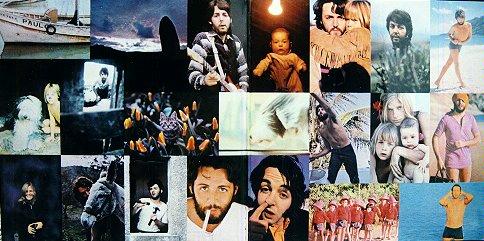
Possibly Paul’s greatest album,  and his first solo , was released in 1970. It is notable for the fact that McCartney, a multi instrumentalist, performed the entire album (all instruments and voices) by himself, except for some backing vocals from his first wife, Linda McCartney. McCartney stated that he played "bass, drums, acoustic guitar, lead guitar, piano, Mellotron, organ, toy xylophone, and bow and arrow" on the album. Notable, also, is the use of a large number of instrumental tracks.

Paul's solo album, simply entitled McCartney, doesn't please the critics because of its simplicity and its under-production. Anyway the album reaches #2 in the charts, right behind Bridge Over Trouble Water by Simon and Garfunkel. And even more, Paul McCartney will soon been awarded with a Golden Record for his solo work.

This first solo album will stay among the favorite ones for many Paul's fans despite the simplicity of the production.

The album starts with The Lovely Linda, which is a short song that was used by Paul to test his four tracks studio.

Then follows That Would Be Something, a nice acoustic ballad backed up by an electric guitar and by some percussions. It really has a countryish style in it. This song will be covered again by Paul 21 years later for the MTV Unplugged program in January 1991. This live cover will be included on Paul's Unplugged album.

Next comes Valentine Day, an instrumental title mostly based on Paul's electric guitar solo. A skilful rendering.

The fourth track is a nice acoustic ballad entitled Every Night.


PAUL McCartney - EVERY NIGHT 1970

It's one of the bests songs on this album. Paul will cover this title many times during his solo career, especially during the 1979' Wings Tour (a live recording can be found on the Concert For The People Of Kampuchea album). It will also be performed as part of the MTV Unplugged program in January 1991.

McCartney album: it's called Hot As Sun and was written by Paul in 1959. At the end of this song, there is some musical link called Glasses which lasts a few seconds and features an excerpt of Suicide, an unreleased song by Paul. Even today the complete Suicide recording can only be found on some bootleg albums.

Then follow Junk which was written by Paul in 1968 during the Indian stay with the Beatles in Maharishi's home in Rishikesn. This is a simple and melancholic ballad played on the acoustic guitar.
Man We Was Lonely is the next track and it brings us some joyful atmosphere. It is a special track as it is the first song ever written together by Paul and Linda.

Oo You comes then as a strong rock song with straight electric guitar lines in the background. It's followed by an instrumental composition, Momma Miss America, in which Paul can exhibit all his skill in playing various instruments and particularly the drums. A good electric guitar solo dominates the second half of the song.

Another nice acoustic ballad follows with Teddy Boy which was rejected from the Beatles' Let It Be album. Like Junk, it was written by Paul in 1968 during the Indian stay with the Beatles in Maharishi's home in Rishikesn.

The next song, Singalong Junk, is an instrumental variation on the theme of the previous Junk composition. It features a beautiful orchestration on piano and acoustic guitar. A newer cover of this instrumental song can be found on Paul's Unplugged album that was recorded during the MTV Unplugged program in 1991.

But the strongest title on this album is definitely Maybe I'm Amazed, a wonderful ballad played on piano and enhanced by an unforgettable electric guitar solo. This tremendous song will remain one the most famous masterpieces composed by Paul.

It will be covered many times by Wings on stage and more recently by Paul and his band during the 89/90' World Tour. Some of these astounding recordings can be found on
Wings Over America and on Tripping The Live Fantastic.

Amazingly, no single will be released from the McCartney album. Clearly Maybe I'm Amazed should have been this missing single. This unfairness will be repaired in April 1977 with the release of the single Maybe I'm Amazed / Soily taken from Wings Over America.

The last title of the McCartney album, Kreen-Akrore is an instrumental and experimental composition with some unusual percussion rhythms and a more classical electric guitar line to end the track.

By far one of the best albums he has ever made and a personal favorite, give it a chance and listen. Link to download will be posted in comments.
Monday, July 13, 2009

Fox News

To depart from my usual music or political blog I must write the following and hope someone will comment and set me straight if I am wrong.

Fox news and especially Hannity is crazy! I have been trying to watch the channel for the last week and can’t understand how people can be so blind and believe everything he says.

Now I have not watched anyone other than Hannity, O’Reilly and Glenn Beck but I’m just appalled at some of the things and people they bring on their shows. Like a guest on Glenn Beck that Obama should bomb us again :


I mean people!!! how stupid can you be this is crazy. And right now I’m watching their reporting on the Sotomayor confirmation hearings; I just don’t know what to think.

Tuesday, July 7, 2009

Iraq pullback and unrest in Honduras

Monday, July 6, 2009

Ousted Ex-President of Hondurans Can Not Land

Saturday, July 4, 2009

Honduras Defends Its Democracy

Fidel Castro and Hillary Clinton object.

Hugo Chávez's coalition-building efforts suffered a setback yesterday when the Honduran military sent its president packing for abusing the nation's constitution.

It seems that President Mel Zelaya miscalculated when he tried to emulate the success of his good friend Hugo in reshaping the Honduran Constitution to his liking.

But Honduras is not out of the Venezuelan woods yet. Yesterday the Central American country was being pressured to restore the authoritarian Mr. Zelaya by the likes of Fidel Castro, Daniel Ortega, Hillary Clinton and, of course, Hugo himself. The Organization of American States, having ignored Mr. Zelaya's abuses, also wants him back in power. It will be a miracle if Honduran patriots can hold their ground.

That Mr. Zelaya acted as if he were above the law, there is no doubt. While Honduran law allows for a constitutional rewrite, the power to open that door does not lie with the president. A constituent assembly can only be called through a national referendum approved by its Congress.

But Mr. Zelaya declared the vote on his own and had Mr. Chávez ship him the necessary ballots from Venezuela. The Supreme Court ruled his referendum unconstitutional, and it instructed the military not to carry out the logistics of the vote as it normally would do.

The top military commander, Gen. Romeo Vásquez Velásquez, told the president that he would have to comply. Mr. Zelaya promptly fired him. The Supreme Court ordered him reinstated. Mr. Zelaya refused.

Calculating that some critical mass of Hondurans would take his side, the president decided he would run the referendum himself. So on Thursday he led a mob that broke into the military installation where the ballots from Venezuela were being stored and then had his supporters distribute them in defiance of the Supreme Court's order.

The attorney general had already made clear that the referendum was illegal, and he further announced that he would prosecute anyone involved in carrying it out. Yesterday, Mr. Zelaya was arrested by the military and is now in exile in Costa Rica.

It remains to be seen what Mr. Zelaya's next move will be. It's not surprising that chavistas throughout the region are claiming that he was victim of a military coup. They want to hide the fact that the military was acting on a court order to defend the rule of law and the constitution, and that the Congress asserted itself for that purpose, too.

Mrs. Clinton has piled on as well. Yesterday she accused Honduras of violating "the precepts of the Interamerican Democratic Charter" and said it "should be condemned by all." Fidel Castro did just that. Mr. Chávez pledged to overthrow the new government.

Honduras is fighting back by strictly following the constitution. The Honduran Congress met in emergency session yesterday and designated its president as the interim executive as stipulated in Honduran law. It also said that presidential elections set for November will go forward. The Supreme Court later said that the military acted on its orders. It also said that when Mr. Zelaya realized that he was going to be prosecuted for his illegal behavior, he agreed to an offer to resign in exchange for safe passage out of the country. Mr. Zelaya denies it.

Watch more iReport videos on AOL Video

Many Hondurans are going to be celebrating Mr. Zelaya's foreign excursion. Street protests against his heavy-handed tactics had already begun last week. On Friday a large number of military reservists took their turn. "We won't go backwards," one sign said. "We want to live in peace, freedom and development."

Besides opposition from the Congress, the Supreme Court, the electoral tribunal and the attorney general, the president had also become persona non grata with the Catholic Church and numerous evangelical church leaders. On Thursday evening his own party in Congress sponsored a resolution to investigate whether he is mentally unfit to remain in office.

For Hondurans who still remember military dictatorship, Mr. Zelaya also has another strike against him: He keeps rotten company. Earlier this month he hosted an OAS general assembly and led the effort, along side OAS Secretary General José Miguel Insulza, to bring Cuba back into the supposedly democratic organization.

The OAS response is no surprise. Former Argentine Ambassador to the U.N. Emilio Cárdenas told me on Saturday that he was concerned that "the OAS under Insulza has not taken seriously the so-called 'democratic charter.' It seems to believe that only military 'coups' can challenge democracy. The truth is that democracy can be challenged from within, as the experiences of Venezuela, Bolivia, Ecuador, Nicaragua, and now Honduras, prove."

A less-kind interpretation of Mr. Insulza's judgment is that he doesn't mind the Chávez-style coup.

The struggle against chavismo has never been about left-right politics. It is about defending the independence of institutions that keep presidents from becoming dictators. This crisis clearly delineates the problem. In failing to come to the aid of checks and balances, Mrs. Clinton and Mr. Insulza expose their true colors.


Wednesday, July 1, 2009

The Cinematic Orchestra - Every day [2002]


An old music-press adage claims that second albums are notoriously "difficult." If this were true, then Every Day should be one big disappointment. The fact that it's arguably one of 2002's finest jazz albums ( yes, jazz--as in real, old-fashioned, clarinets-and-trumpets jazz ) proves how talented Jason Swinscoe's Cinematic Orchestra are. Following up their impeccable debut, Motion, was going to be tough, but they've surpassed themselves here. While the former was a fusion of sample-culture smoky, backroom jazz, Every Day is jazz pure and simple--old jazz for the nu-jazz generation. "Man with the Movie Camera," "Burnout," and "Flite" are near-perfect soundtrack jazz pieces: epic, shuffling, ever shifting. "All That You Give" and "Evolution" highlight the enchanting vocals of legendary soul singer Fontella Bass. Best of all, though, is the Roots Manuva collaboration "All Things to All Men"--proof that jazz and rap aren't as strange bedfellows as some may think.

With Every Day, Cinematic Orchestra move beyond the electro-jazz fusion of their debut to make a record more natural, more paced, and, surprisingly, better than the justly hyped Motion. J Swinscoe is more the arranger/conductor here than the producer, but of course, there's little need for samples or effects with such an accomplished band sharing the burden. For the opener "All That You Give," Swinscoe and Co., plus harp player Rhodri Davies, spend a few minutes delicately paving the way for a deeply felt vocal by soul hero Fontella Bass. "Burn Out" is a lush, meditative track with a pleasantly ambling solo from Phil France on electric piano, a few appropriately cinematic-sounding horns, an age-old vocal sample, and occasional creaking static phasing through. Bass returns for another splendid track ( "Evolution" ), and the mighty Roots Manuva appears on a magisterial, spoken-word quasi-autobiography, "All Things to All Men." Except for a pair of detours into highly programmed "broken beat" production, Every Day is a textured, acoustic work; Cinematic Orchestra take their time setting up these songs -- of the seven tracks, four last over nine minutes. The sounds and styles heard may not be revolutionary, but instead of simply pushing stylistic boundaries, Cinematic Orchestra display a real gift in making emotional, artistic music.


Personnel:
Jason Swincoe (Arranger and Sampling)
Patrick Carpenter (Turntables and Electronics)
Milo Fell (Percussion)
Luke Flowers (Drums)
Phil France (Double Bass, Bass Guitar and Electric Piano)
John Ellis (Keyboards)
Roots Manuva (Spoken Words) - 6
Fontella Bass (Vocals) - 1,4
free counters